Dish Brush vs Sponge: Hygiene, Durability and What to Stock
Weighing dish brush vs sponge for your next range review? The honest answer is that both sell, and the interesting question is why. Sponges win on shelf price and on softness against delicate surfaces. Brushes win on drying speed, on reach into hot water, and on how long a shopper keeps one before throwing it out. A range that carries only one of the two leaves a sale behind, or hands a rival the add-on pick. Below: how each tool dries, what that means for hygiene, how they handle heat and grease, why long handles matter, and how to stock both without doubling your SKU count.
How each one dries after the wash
Start here. Drying decides almost everything else.
A sponge is built to hold water. That is the point of it: open, porous structure, water drawn in and held. Cleaning sponges are usually cellulose or foam, and natural sea sponges are still sold, all of them porous by nature (Sponge (tool), Wikipedia). Squeeze one out and it still reads damp an hour later. Leave it in the bottom of a sink and it stays wet far longer than that.
Brushes are the opposite kind of object. Bristles are fibres fixed to a handle, and water runs off them rather than into them (Brush, Wikipedia). A brush stood on its handle or hung on a hook is exposed to air on nearly every surface. That is why a dish brush feels dry by the next meal and a sponge does not.
One caveat worth repeating to your packaging team: the base of a bristle tuft holds water and food. A brush that never drains is barely better than a sponge. Drainage design matters, so if you sell a brush with a holder, spec a ventilated one. The same principle runs through every wet tool we sell. Our product team's own notes on mops draw the line between tools that spread water evenly and tools that let you control how much stays behind.
Hygiene: the part shoppers actually ask about
Nobody buys a dish brush because of microbiology. They buy it because the last sponge smelled. The mechanism is simple and worth putting on pack copy: moisture plus food residue plus warmth makes a friendlier environment for microbes than a dry surface does. A tool that dries between uses has a shorter wet window than one that sits damp in a sink well.
Brushes are not sterile either. Grease collects at the base of the tufts, and a brush used on a greasy pan then rinsed under cold water keeps a film. The habit is the same for both tools: rinse, shake out, dry in the open, replace when it smells or the surface starts breaking down.
For retailers this is an education opportunity, not a claim. "Drains and dries between uses" is factual and safe. Antibacterial wording is not, unless you hold test data for that specific product. Ask us what documentation exists before anything like that goes on a card.
Heat, grease and scratching
This is where the two diverge in daily use.
Sponges soften in hot water, and the abrasive scouring pad bonded to many of them will dull a nonstick coating and mark gloss surfaces over time. That is a genuine reason people keep a brush for the pan and a sponge for the glass. It also explains why so many kitchens end up with both, which is your merchandising opening.
Bristles take heat better, and stiffness can be tuned. In our bristle material notes, PP is the stiffest and cheapest option, PET balances spring with wear resistance, and nylon resists moisture and cleans gently. For dish work, nylon and PET are the natural picks: stiff enough for burnt-on food, kind enough to a coated pan.
Grease is the harder problem. Bristles trap it. A dense tuft with a stiff inner core scrubs better and rinses worse. Every design trades one against the other, so decide which job the SKU is for before anyone picks a bristle. Our Pot Brush is the heavy end of that trade: virgin PP body, dense nylon/PET tufts set with rustproof metal staples, built for cooked-on food.
Long handles change who does the washing
A sponge puts your hand in the water. A long-handled brush does not.
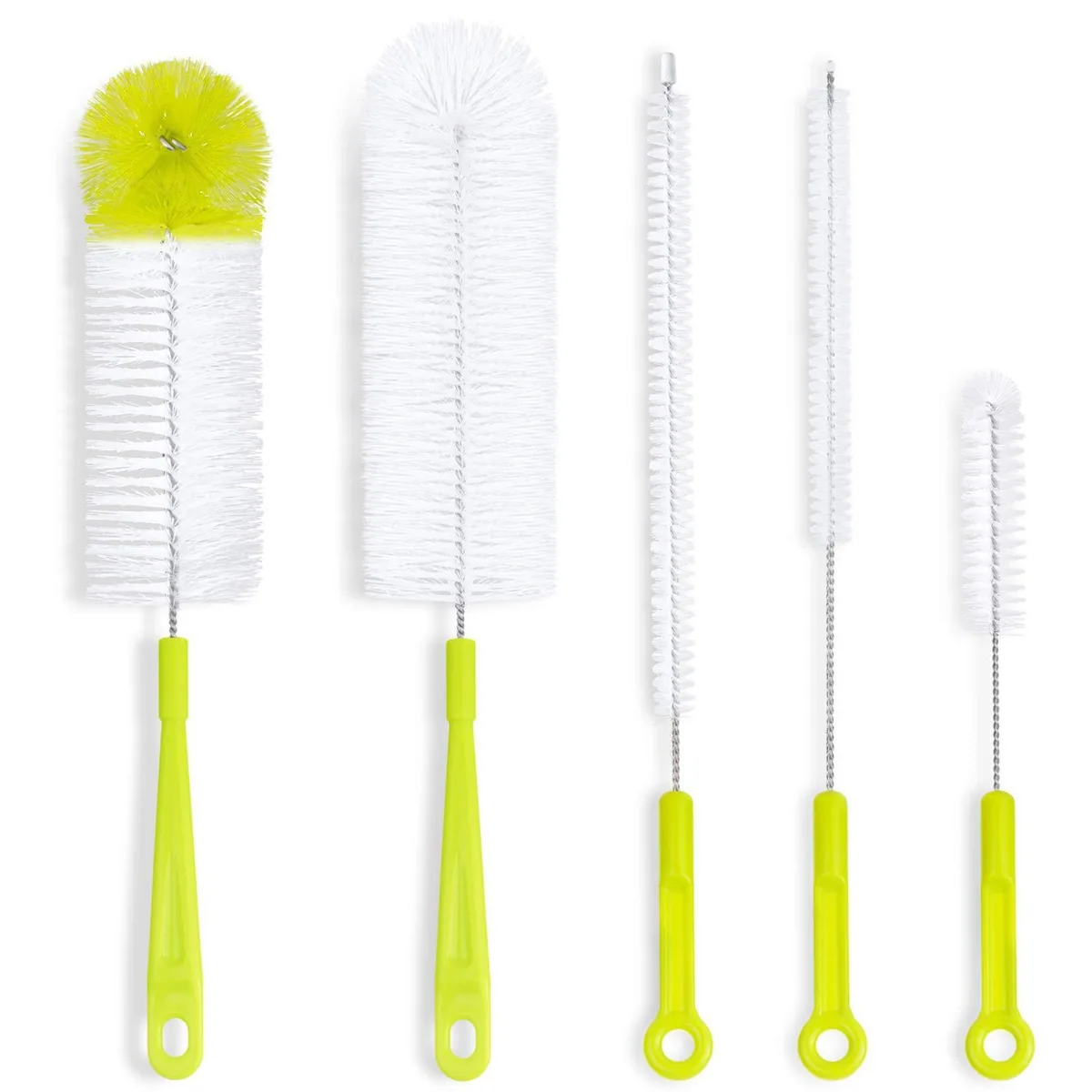
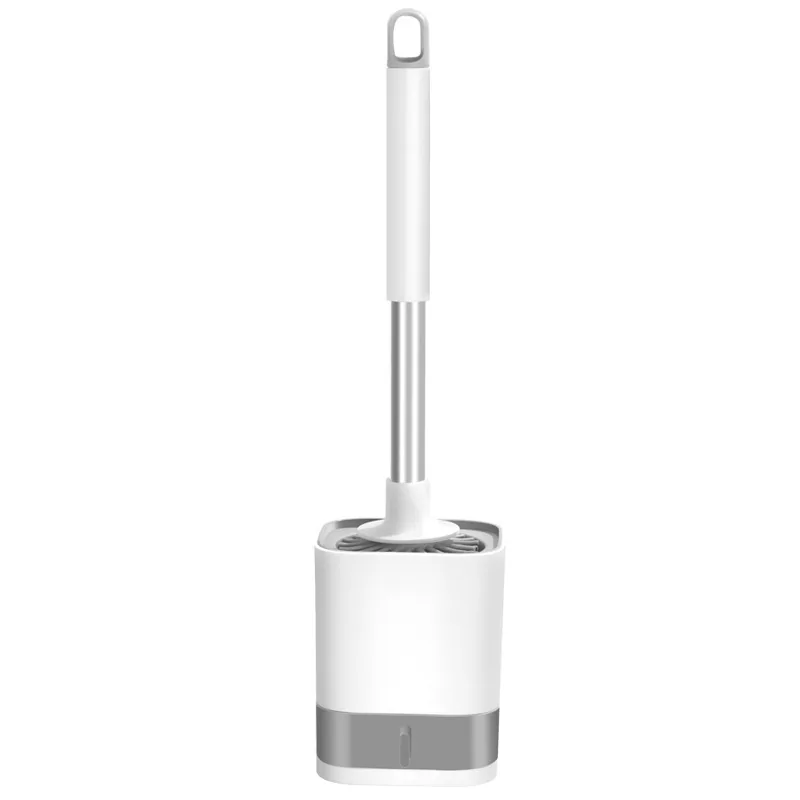
That single difference sells brushes to shoppers with sensitive skin, to anyone washing a deep stockpot, and to people who simply dislike the feel of greasy water on their fingers. Take our Long-Handle Plastic Dish and Pot Brush: a plastic bristle head on a long handle, so you can scrub a saucepan or a deep mug without your fingers going in. Minimum order on that listing is 1,440 pcs.
Handle quality decides whether the tool survives the first month. Ours use reinforced stainless steel or aluminium at 0.4 to 0.6 mm wall thickness, and products must pass a drop test before they leave the factory. Not glamorous work. It is what keeps returns down.
Narrow necks are the same story at smaller scale. A sponge cannot get past the shoulder of a bottle. Our Long-Reach Plastic Bottle Brush Set (MOQ 1,000 pcs) and Plastic Bottle and Cup Cleaning Brush (MOQ 1,500 pcs) exist for exactly that gap.
Replacement: the retail maths
Sponges are consumables. Brushes are durables. That sentence explains most of the merchandising.
A sponge buyer comes back, which makes multipacks easy to sell because the shopper already knows the item will die. A brush buyer spends more once and returns less often, but the item carries a higher ticket and takes private label branding far better, because there is a handle to print on and a card to design around.
Ignore lifespan claims in weeks, from us or anyone else. Real life depends on water temperature, detergent, how hard the cook scrubs and whether the tool ever gets to dry. Print "replace when worn" and let the shopper judge.
Dish brush vs sponge: side by side
| Factor | Dish brush | Sponge |
|---|---|---|
| Drying | Fast when hung or stood up; water runs off bristles | Slow; porous structure holds water |
| Hygiene profile | Dries between uses, but grease lodges at tuft base | Stays damp longer, especially in a sink well |
| Heat | Bristles tolerate hot water well | Softens and breaks down faster in heat |
| Grease and burnt-on food | Strong, tunable stiffness for scrubbing | Good on light soil, struggles with burnt-on |
| Nonstick and gloss | Gentle if bristle is nylon or PET | Abrasive backing can dull coatings |
| Reach | Long handles keep hands out of hot water | Hand goes into the water |
| Usable life | Longer, if the handle and tufts hold up | Short; usually replaced often |
| Repeat purchase | Lower frequency, higher ticket | High frequency, multipack friendly |
| Private label fit | Strong: handle print, colour, card design | Limited: flat surface, fewer branding options |
| Typical shopper | Pans, bottles, sensitive skin, deep sinks | Quick wipes, delicate items, low price pick |
Stocking both without bloating the range
Three brush SKUs and two sponge SKUs will beat six sponges every time, provided each item has one clear job. A shape that works:
- Entry brush. Short handle, nylon bristles, single pack. This is the switch purchase for a sponge user.
- Long-handle brush. The pot and pan scrubber, sold on reach and hot-water comfort.
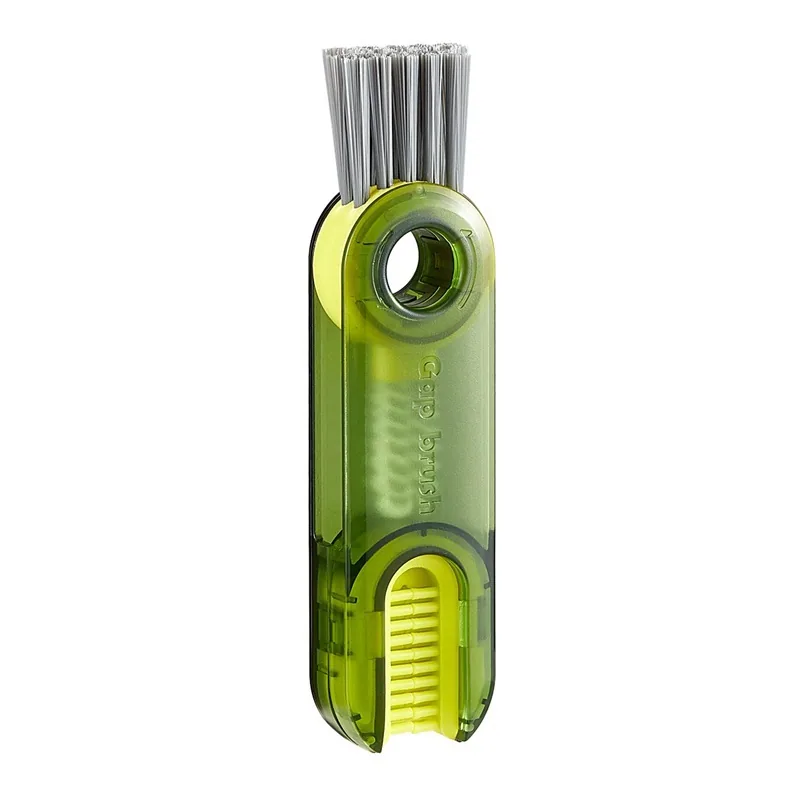
- Specialty. A bottle brush, or a kit for stoves and hoods such as our 3-Piece Gas Stove Cleaning Brush and Scraper Set (MOQ 720 pcs).
- Sponges. One plain cellulose, one with an abrasive side, both in multipacks.
Then let the kitchen brushes range carry the story across the aisle, and cross-sell into brush types so shoppers understand which head does which job. Own brand? Colours matched to Pantone codes or your samples, logo by silk print, heat print or embroidery, plus colour boxes, product labels and carton marks. PCR plastic parts and recycled cotton fibre are available where your market asks for them. Details on the OEM/ODM page.
How to start an order with us
Two routes, and both are simple.
Stock items. Pick from the listings and use each item's own minimum order shown on that listing. We consolidate in Yiwu with the rest of your container, and the export service covers inspection, warehousing, customs clearance, booking and FCL or LCL shipment.
OEM. Minimum order is 2,000 to 8,000 pieces per style per colour. You confirm the quantity, we sign the contract and take a deposit, you send Pantone codes or colour samples plus logo files, and we adjust material, bristle stiffness and handle length for your market. A pre-production sample is confirmed before mass production runs.
Background, if you need it for a supplier file: Zhejiang Chuangjie Commodity Co., Ltd. has traded since 2006 from Yiwu, Zhejiang, with a showroom of more than 200 square metres in District 4 of the International Trade Mart, 3,000+ SKUs and 300+ injection moulding machines. More on our company.
Email mopglohome@gmail.com or send the quote form on the contact page. Tell us the market, the channel and roughly how many SKUs you want. That is enough for us to propose a range.
FAQ
Is a dish brush more hygienic than a sponge?
A brush dries faster because water runs off the bristles instead of soaking in, so it spends less time damp between uses. Neither tool is sterile. Grease still collects at the base of the tufts, so rinse, shake out and dry both in the open, and replace either one when it smells or the surface breaks down.
Which lasts longer, a dish brush or a sponge?
A brush generally lasts longer, since a sponge is a consumable that breaks down in heat and heavy scrubbing. How long either lasts depends on water temperature, detergent, scrubbing force and whether the tool ever dries. We do not quote lifespans in weeks, and we would treat any supplier who does with suspicion.
What is the minimum order for dish brushes?
For stock items, the minimum is shown on each product listing and applies to that item only. For example, the Long-Handle Plastic Dish and Pot Brush is listed at 1,440 pcs, the Long-Reach Plastic Bottle Brush Set at 1,000 pcs and the Plastic Bottle and Cup Cleaning Brush at 1,500 pcs. OEM orders run from 2,000 to 8,000 pieces per style per colour.
Can I get dish brushes in my own colours and packaging?
Yes. We match colours to Pantone codes or your colour samples, apply logos by embroidery, silk print or heat print, and supply colour boxes, hot-stamped logos, carton marks and product labels. Bristle stiffness, mop head material and handle length can be adjusted for your market, and a pre-production sample is confirmed before mass production.