How Often Should You Replace a Toilet Brush?
Ask five buyers how often to replace toilet brush stock and you will get five answers. Ask the people who actually clean the bathrooms and you will get one: when the brush stops doing its job properly. So the honest answer to how often to replace toilet brush heads and holders is not a calendar number. It is a list of visible signals, plus a set of design choices you can control when you source. That second part is where the margin is.
A toilet brush is a simple tool: a handle, a head and usually a holder that keeps it out of sight between uses, which is how the Wikipedia overview describes it. Simple tools wear out in predictable ways. Learn those ways and you can specify brushes that last longer, and sell the replacement to the same household.
Look for these signs, not the calendar
Wear on a toilet brush is mostly visible. Walk through a hotel floor or a sample set and you can spot a tired brush from a metre away.
- Splayed bristles. Filaments bent permanently outward, or a flat worn patch in the middle of the head. The brush still touches the bowl, but it no longer gets under the rim or around the bend, so people push harder and speed up the damage.
- Discolouration that survives cleaning. Grey or brown staining at the tuft roots after a soak means the head has absorbed what it is meant to remove. Rust streaks or pitting on steel parts are the metal equivalent.
- Odour that comes back. If the smell returns within a day of a wash, it lives in the head and the holder, not in the bowl.
- Cracked or stained holder. Hairline cracks in a canister or a split drip tray hold water. Water plus a dark bathroom equals smell.
- Loose head or handle. A wobbling ferrule, a stripped thread or a rusted staple means the next hard scrub ends the brush, usually mid clean.
- Clean results, second effort. When staff do a second pass over the same rim, the brush is worn, not the toilet.
Why brushes wear out at all
Four forces do the work. Bristle fatigue is the obvious one: polymer filaments bend every time you press them against porcelain, and a bent filament does not spring all the way back. Chemistry is the second. Bowl cleaners, descalers and bleach are designed to break down mineral and organic deposits, and they treat brush filaments to the same slow attack over many cycles.
Then there is storage, the factor most buyers ignore. A brush standing in an inch of water inside a closed canister lives in a warm, dark, wet box. That is the ideal environment for odour, and it softens the head faster than any scrubbing. Ventilated holders and removable drip trays exist for a reason.
Mechanical abuse is the fourth. Under-rim geometry forces people to bend and twist the head in ways the brush was not designed for. A head that reaches properly gets abused less, which is why shape matters as much as bristle material.
Toilet brush lifespan: what shortens it, what stretches it
Anyone who quotes one replacement interval for every household is guessing. A single bathroom in a two-person flat and a busy public washroom are not the same job. What you can do is understand the variables.
Makes a brush die faster
- Standing water in a closed holder.
- Bleach or strong descaler left on the head.
- Hard water and heavy limescale, which make people scrub harder.
- Thin, low-density tufts that splay early.
- Cheap staples or coatings that rust and stain the holder.
Makes it last longer
- A ventilated holder with a drip tray that keeps the head off the floor of the canister.
- Rinsing and drying after use, the same habit our guide to cleaning a toilet brush sets out.
- Stiff, dense nylon or PET tufts set with rustproof staples.
- Moulded one-piece handles and holders with no joint to split.
- Wall-mounted sets, which free the floor and dry much faster.
Blunt version: the holder decides how long the brush lives. Buyers spend all their attention on the head and then pack it in a sealed plastic cup.
Materials that hold up
For the handle and holder, polypropylene is the workhorse. It is a thermoplastic that resists water and many household chemicals, and it carries the recyclable resin code 5, as the polypropylene entry explains. Moulded in one piece, it has no seams to split and no plating to flake.
Our Plastic Handled Toilet Brush uses a moulded polypropylene handle and matching holder in high grade virgin PP, with a PCR (post-consumer recycled) plastic option for buyers who need it. Steel has its place too. The Stainless Steel Toilet Brush pairs a corrosion resistant steel handle and canister, both with an oxidised anti-fingerprint coating, with a stiff nylon head.
Bristles are where the engineering really sits. Nylon and PET hold stiffness longer than soft natural fibres and they tolerate bathroom chemistry better. Density matters as much as material, because a sparse tuft leans on fewer filaments and they splay sooner. For a straight comparison of head types, we keep a separate piece on silicone versus bristle toilet brushes.
Brush designs compared, for buyers
| Design | Where it fails first | Lifespan feel | Good fit for |
|---|---|---|---|
| Nylon head, moulded PP handle and holder | Bristle splay, then a cracked canister | Moderate | Volume retail, value packs, supermarket promotions |
| Nylon head, stainless steel handle and canister | Bristles before steel; coating if scoured hard | Moderate to long | Hardware chains, higher ticket bathroom sets |
| Silicone head, wall-mounted | Head ageing, wall bracket or adhesive | Long, if rinsed after use | Small bathrooms, apartments, rental stock |
| Refillable head on a kept handle | Head only, by design | Handle outlasts several heads | Private label with a repeat purchase plan |
| Brush and plunger or suction cup combo | Bristles, then the caddy drip tray | Moderate | Bathroom sets, seasonal and bundle offers |
Replaceable heads and wall-mounted designs
A refill head changes the economics. With a fixed-head brush, the second sale depends on the customer noticing wear and remembering to buy a whole new brush. With a refill, the handle stays and the repeat purchase is small, obvious and easy to merchandise next to the original.
Wall-mounted sets do something similar for hygiene. Off the floor, out of the puddle, drying in air, and the head lasts longer. Our Wall-Mounted Silicone Toilet Brush Set uses a silicone or rubber style head with plastic and aluminium parts, and the Wall-Mounted Long-Handle Silicone Toilet Brush adds reach for cleaning while standing.
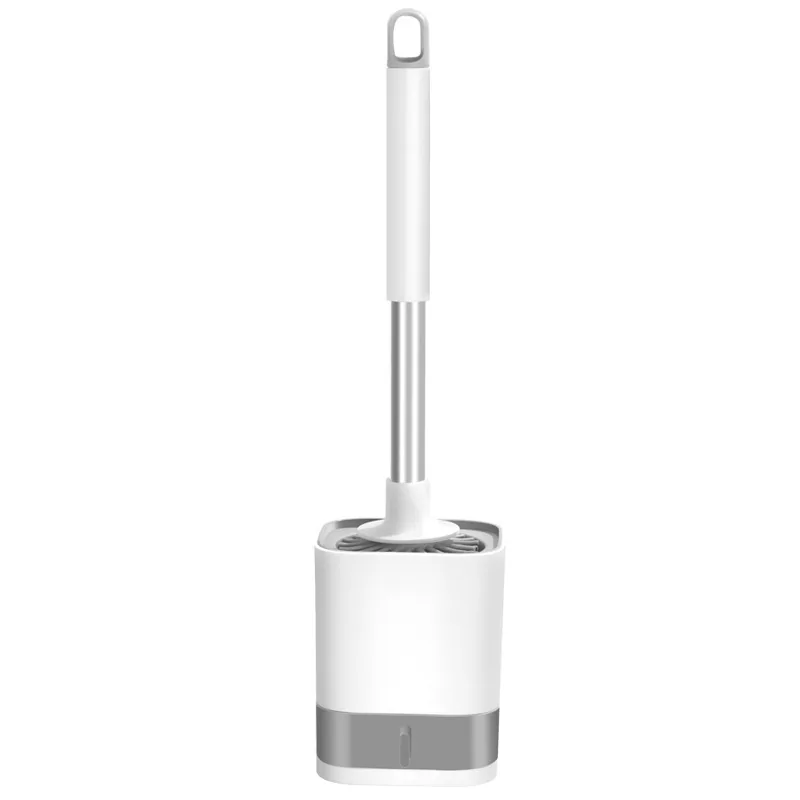
Two-piece caddies solve a different problem: nobody wants to store a plunger next to a brush in the open. The Toilet Brush and Plunger Set and the Toilet Brush and Suction Cup Set put both tools in one ventilated base with an internal drip tray, which is exactly the drying detail that extends head life. The full bathroom line sits under toilet brushes.
What this means for your range
Three practical decisions, none of them expensive.
- Specify splay resistance, not just bristle colour. Ask for tuft density, filament stiffness and rustproof staples. These are the specs that decide whether a brush feels good in month one and still works later.
- Fix the storage problem in the design. Ventilation holes, a drip tray, a holder tall enough that the head does not sit in its own water. Cheap to mould, hard for a competitor to copy in a photo.
- Plan the second sale. Multi-packs, or a bathroom set that bundles brush and plunger. If your market wants head-only refills, that belongs in the OEM conversation, where fit and packaging can be specified.
Retailers in the UK, US, Australia and South Africa tend to ask us the same question in different words: what makes a brush last in a damp bathroom? The answer is boring and reliable. Dense tufts, a one-piece moulded body and a holder that lets air in. Everything else is decoration.
How to start an order with us
CHUANGJIE (product brand Mopglo) has been making household cleaning tools in Yiwu, Zhejiang since 2006, with more than 3,000 SKUs across brushes, mops, brooms and bathroom items. Two routes.
Stock items. Pick from the toilet brush range, where each listing shows its own minimum order (the Wall-Mounted Silicone Toilet Brush Set is listed at 400 pcs, the long-handle wall-mounted version at 1,500 pcs). Where a listing says ask, ask us.
OEM and ODM. We match colours to Pantone codes or your samples, apply logos by embroidery, silk print or heat print, and produce colour boxes, hot-stamped logos, carton marks and product labels. Brush bristle stiffness, handle length and head material can be adjusted for your market, and a pre-production sample is confirmed before mass production. OEM minimums run 2,000 to 8,000 pieces per style per colour. Production sits on 300+ injection moulding machines with annual output over 5 million units, products pass a drop test before leaving the factory, and the export side covers inspection, warehousing and consolidation in Yiwu, customs clearance, booking and shipment by FCL or LCL.
Email mopglohome@gmail.com with the item, quantity and market, or send the quote form and our team will come back with options. More on custom work sits on the OEM and ODM page.
FAQ
How often should you replace a toilet brush?
There is no single interval that fits every household, and any supplier who quotes one is guessing. Replace on visible wear: bristles splayed outward, a flat patch in the head, staining that survives a soak, odour that returns within a day, or a cracked holder. A brush kept in a ventilated holder and rinsed after use reaches those signs later than one standing in water.
How do you know when to replace toilet brush heads specifically?
Look at the head, not the handle. If the tufts have lost their spring, if the outer filaments bend flat against the bowl instead of reaching under the rim, or if the head needs a second pass to clean the same spot, the head is done. On a steel brush, rust streaks or pitting around the staples are a second signal.
Do silicone toilet brushes last longer than bristle brushes?
They age differently rather than simply lasting longer. A silicone head does not splay like a tufted head and rinses clean easily, but the grip is softer, so some users scrub harder on limescale. A dense nylon head keeps its bite but loses it once the filaments bend. Match the head to the water and the user, and keep the holder ventilated either way.
Can you supply replacement heads or a private label toilet brush range?
Head-only refill packs are not a standard stock item in our bathroom range today, but the refill question fits naturally into an OEM project, where head fit, packaging and carton marks are specified and a pre-production sample is confirmed before mass production. OEM minimums run 2,000 to 8,000 pieces per style per colour. Email mopglohome@gmail.com or use the quote form.